 |
| Clover field: After being cut with a bush hog |

Showing posts with label clover field. Show all posts
Showing posts with label clover field. Show all posts
Sunday, October 24, 2010
Clover Field: The end
It turns out that the clover field was a massive flop. It grew well but it never flowered.
I should have taken my fathers advice and cut it down when it was 2 ft tall. I was expecting it to flower at any time and it never ended up doing that. The weeds also grew in quite thick. There must have been only a couple of dozen flowers total. It was cut for the winter, we will see what the spring will bring.
Sunday, May 9, 2010
First Spring bloom
This is from a few days back. I am just getting the time to update my blog. When we got home from the hospital everything was in bloom.
Here is a web album that shows a lot of pictures of what it looked like here at the end of last week. It was gorgeous.
I also took off my formic acid pads from my hives. They will be needing honey supers added on top so they do not have the urge to swarm.
Here is a web album that shows a lot of pictures of what it looked like here at the end of last week. It was gorgeous.
I also took off my formic acid pads from my hives. They will be needing honey supers added on top so they do not have the urge to swarm.
Monday, April 5, 2010
Clover field planted... in the dark
Tonight I took the opportunity to open up the two double box hives that I have at home. I knew that they were strong but I was surprised at how strong they actually are. The green hive was opened first and to my surprise, they still have a lot of their honey remaining and several frames of pollen. It is pretty incredible to see some full frames of pollen this early in the year; there were also some very young eggs in this top box. I lifted off the top box and it was quite heavy. I checked the bottom box and it was equally full of pollen and honey.
 When separating the boxes some developing pupae were exposed. These are likely drone cells which are built between the cells. They are more susceptible to mite infestations and a good indication as to mite infestation. This calls for a mite drop count to see if I should treat. I did see some drone bees out already.
The white hive had a lot of honey in the top box but not as much pollen as the green hive. I lifted the top box off and took a look at the bottom box. It has a lot of pollen and a lot of room for eggs in the bottom. I did find some very young eggs in the bottom box. The box was quite a bit lighter so I decided to change the bottom box with the top box. The bees like to store their honey higher up in the hive, so this will allow them to use their stored honey to build up their hives and this also gives them room to store honey in the now emptier box.
I checked the week forecast and I saw that they are calling for rain for the rest of the week. So I called my dad and we decided to try to seed the yellow clover in the dark. Here is a picture of what the seed actually looks like:
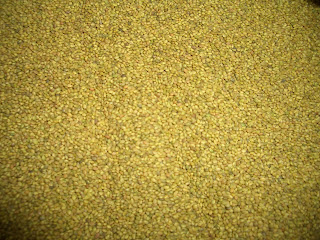 The smell of the seeds was quite sweet, hence the name. We had some issues with the seeder. We used a battery powered seeder mounted to the back of an ATV. We then packed the field down. Time will only tell if the seeds were spread properly.

The white hive had a lot of honey in the top box but not as much pollen as the green hive. I lifted the top box off and took a look at the bottom box. It has a lot of pollen and a lot of room for eggs in the bottom. I did find some very young eggs in the bottom box. The box was quite a bit lighter so I decided to change the bottom box with the top box. The bees like to store their honey higher up in the hive, so this will allow them to use their stored honey to build up their hives and this also gives them room to store honey in the now emptier box.
I checked the week forecast and I saw that they are calling for rain for the rest of the week. So I called my dad and we decided to try to seed the yellow clover in the dark. Here is a picture of what the seed actually looks like:

Thursday, April 1, 2010
Clover Field Plowing
Last night my dad showed me exactly how to plow a field. We are borrowing a small plow from an uncle and we have it on our small loader tractor. My dad is used to plowing with a 6 or 7 furrow; but this small one is a 3 furrow (even easier to use). Like I had said earlier, there is a pasture beside my beehives which is not really used and it has old grasses in it so I am plowing one of the available four acres to put clover in it. We are squaring up the awkward angle part of the pasture.

Here is a picture of the single hives which are side by side and they no longer have the insulation around them. They look a bit odd. As you can see there is a lot of activity. Today after work, I went to my parents farm and cleaned their new home up by cutting off some dead branches which will be above their hives. Last thing I need is a dead branch breaking off and destroying my hives. I plan on moving them early in the morning. The location is roughly 7 kms as the crow flies. This is a perfect distance; for the bees will not make their way back to their original location.
 This shows the hustle and bustle of my two larger hives. They too were taking advantage of the nice weather and collecting lots of pollen and water.
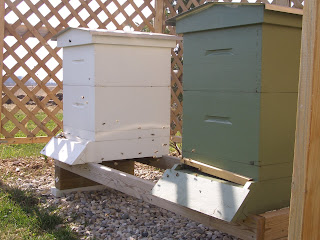

Here is a picture of the single hives which are side by side and they no longer have the insulation around them. They look a bit odd. As you can see there is a lot of activity. Today after work, I went to my parents farm and cleaned their new home up by cutting off some dead branches which will be above their hives. Last thing I need is a dead branch breaking off and destroying my hives. I plan on moving them early in the morning. The location is roughly 7 kms as the crow flies. This is a perfect distance; for the bees will not make their way back to their original location.


Saturday, March 27, 2010
Sweet Yellow Clover Field
I have been contemplating what to do with a pasture field right by my bee hives. There has not been any cattle in the field for over 2 years and we do not need the hay for our livestock. I was researching northern nectar sources on the internet and found a great summary of different plants. See the link from none other than Wikipedia:
This points out a lot of great sources. I choose to do the clover because it is readily available in my area and it will not spread like a weed to my other organic fields and I could still have cattle graze the pasture. At the end of the blossom I could also bale it and use it as hay (even though yellow clover looks a bit too coarse of a stock) and it must be properly dried or it acts like an anti-coagulant (ex: rat poison).
Wikipedia claims that sweet yellow clover can yield up to 500lbs of honey per acre and I plan on only changing over 1 acre of 4 to sweet yellow clover. I am excited with the idea of a close source of nectar from May to August!
 I bought my organic sweet yellow clover seed from a local supplier; he recommended 20lbs per acre. I was able to purchase the bag for $34. I have to plow the old pasture up and disc it to break it up and then sow it. I also plan on running a pass with the packer.
This points out a lot of great sources. I choose to do the clover because it is readily available in my area and it will not spread like a weed to my other organic fields and I could still have cattle graze the pasture. At the end of the blossom I could also bale it and use it as hay (even though yellow clover looks a bit too coarse of a stock) and it must be properly dried or it acts like an anti-coagulant (ex: rat poison).
Wikipedia claims that sweet yellow clover can yield up to 500lbs of honey per acre and I plan on only changing over 1 acre of 4 to sweet yellow clover. I am excited with the idea of a close source of nectar from May to August!

Subscribe to:
Posts (Atom)